

Many people ask, “does computer hardware engineering involve math?” Yes, math is a core component of hardware design and analysis. Required skills vary by role, but every engineer needs a solid mathematical foundation.
Computer hardware engineering uses math for circuit design, signal analysis, and electronic device models. Engineers also evaluate performance, manage heat dissipation, estimate reliability, and verify digital systems.
Aspiring engineers should focus on these subjects: calculus, linear algebra, Boolean algebra, probability, statistics, discrete mathematics, electromagnetics, and semiconductor physics. Advanced equations are not needed every day, but algebra, trigonometry, and logical reasoning remain vital. This hardware engineering math helps students prepare for success.
Understanding math requirements for hardware engineers can feel practical and reassuring. Math helps with component selection, power consumption, timing analysis, and circuit troubleshooting.
Key Takeaways
- Mathematics is essential for various tasks in hardware design.
- Core subjects include calculus, linear algebra, and Boolean algebra.
- A strong foundation in algebra and trigonometry is necessary.
- Real-world applications of math enhance practical understanding.
- Different roles may require different levels of mathematical expertise.
Does Computer Hardware Engineering Involve Math?
Mathematics plays a major role in computer hardware engineering and supports many design tasks. Engineers use arithmetic, calculus, and other methods to solve problems in processor design, radio-frequency systems, and semiconductor development.
The Short Answer: Yes, Significantly
Mathematics guides computer hardware engineering, while electrical engineering math supports circuit work. Engineers use hardware design mathematics to ensure components work correctly. Basic arithmetic and algebra help determine voltage, current, and resistance, while more complex projects require calculus, differential equations, and matrix operations.
How Math Shapes Day-to-Day Hardware Engineering Tasks
During daily work, hardware engineers use math for several important tasks. They calculate voltage and current levels, resistance and capacitance values, and inductance and power consumption. They also calculate clock timing, propagation delays, thermal limits, and heat dissipation.
- Voltage and current levels
- Resistance and capacitance values
- Inductance and power consumption
- Clock timing and propagation delays
- Thermal limits and heat dissipation
Computer engineering coursework helps engineers interpret graphs, datasheets, and simulation outputs. Software tools automate many calculations, but engineers still need to understand the underlying mathematics. This knowledge helps them choose suitable models, spot unrealistic outputs, and make informed design decisions.
| Mathematical Concept | Application in Hardware Engineering | Importance |
|---|---|---|
| Arithmetic | Basic component calculations | Essential for everyday tasks |
| Algebra | Circuit analysis | Helps solve equations for unknowns |
| Calculus | Signal processing | Crucial for understanding changes |
| Statistics | Reliability analysis | Informs quality control measures |
Why Mathematics Is Essential in Hardware Engineering
Mathematics is more than an academic requirement; it is vital for successful hardware engineering. It supports hardware engineering problem-solving by helping engineers divide complex systems into manageable parts. This method helps them set limits, compare trade-offs, and check conclusions.
When a circuit becomes unstable, math helps engineers isolate variables and find the root cause. If power use rises too high, math helps them locate the source. Engineers also use math to check whether signals meet timing requirements.
The Foundation of Logical Problem-Solving
Mathematics gives engineers tools for a methodical approach. By dividing challenges into smaller parts, they can handle each one with care. This structure matters in hardware engineering because small errors can cause major failures.
Math as the Language of Hardware Design Tools
In hardware design, mathematics works as a universal language. Design programs use equations, algorithms, and logical rules to show electrical and physical behavior. This shared mathematical model helps engineers and tools communicate clearly.
Electronic Design Automation Software
Electronic design automation (EDA) software shows how math supports hardware engineering. These tools support schematic capture, printed circuit board layout, integrated circuit design, timing analysis, and verification. Each process uses mathematical models for accuracy and efficiency.
Simulation and Modeling Platforms
Simulation and modeling platforms help engineers predict behavior before building physical prototypes. Using hardware modeling, they can forecast voltage behavior, frequency response, heat distribution, and electromagnetic effects. This prediction helps them find possible problems early in design.
Mathematical literacy helps engineers understand the limits of circuit simulation software. It helps them separate useful results from modeling errors. This understanding leads to more reliable designs.
| Aspect | Mathematical Role | Examples |
|---|---|---|
| Problem-Solving | Logical breakdown of issues | Identifying circuit instability |
| Design Tools | Language for representation | EDA software applications |
| Simulation | Predictive modeling | Voltage and frequency analysis |
Core Mathematical Disciplines in Computer Hardware Engineering
Several mathematical fields support computer hardware engineering design and analysis. Engineers need these core areas to manage modern hardware systems. Each field matters differently in digital design, analog systems, and semiconductor technology.
Calculus
Calculus is fundamental in hardware engineering because it analyzes continuously changing electrical signals. It models current, temperature variations, and control system behavior. It helps predict system responses over time, making calculus in hardware engineering essential for reliable solutions.
Linear Algebra
Linear algebra is essential for analyzing complex hardware problems. Linear algebra in computer engineering uses matrices, systems of equations, and transformations. It supports circuit analysis, graphics processing, and machine learning accelerators.
Engineers use it to optimize performance and solve problems with many variables.
Boolean Algebra
Boolean algebra provides the formal foundation for digital logic design. Boolean algebra circuits use binary operations, logic gates, and circuit simplification. It is essential for engineers designing efficient processor control paths and correct digital circuits.
Probability and Statistics
Probability and statistics help engineers understand manufacturing variations and component reliability. Probability in engineering supports analysis of error rates, signal integrity, and hardware defects. Statistical methods improve quality control and testing, helping products meet strict performance standards.
Discrete Mathematics
Discrete mathematics supports algorithms, graph structures, and finite-state machines. Discrete mathematics hardware design uses these tools in digital systems and verification processes. Software and digital design engineers use it to create efficient solutions and verify system functionality.
The value of each mathematical discipline depends on an engineer’s specialization. For instance, digital design engineers often use Boolean and discrete mathematics. Analog or RF engineers may rely more on calculus and differential equations.
Mastering these core disciplines is crucial for success in computer hardware engineering.
Calculus Applications in Hardware Design
In hardware design, calculus helps engineers understand and improve complex systems. They study hardware behavior across time, distance, frequency, and temperature. These methods support calculus applications in electronics, signal processing, thermal models, and control systems.
Signal Processing and Frequency Analysis
In signal processing, calculus helps engineers track waveform changes. They use derivatives and integrals to study signal changes for filtering and sampling. With Fourier analysis, they split complex signals into parts, reduce noise, and improve communications hardware.
Calculus helps engineers study how circuits respond to different frequencies. This work supports analog and digital systems and forms key signal processing mathematics. Engineers can then design devices that work well under changing conditions.
Thermal Modeling and Power Consumption
Calculus supports thermal modeling hardware by predicting heat and temperature changes. This helps engineers estimate energy use and transient behavior, which affect processor performance and battery life.
Calculus helps engineers find cooling needs for parts such as heat sinks and fans. This knowledge helps prevent thermal throttling, which can lower performance. Engineers can build reliable systems that keep safe temperatures and use power efficiently.
Control Systems in Embedded Hardware
In embedded systems, calculus guides the design of control systems. Engineers model feedback loops in motor controllers and robotics platforms. These models show stability, response time, and error correction in embedded control systems.
Calculus helps engineers make embedded hardware respond safely and predictably to inputs. This matters in automotive systems and industrial equipment, where precise control supports function and safety.
Linear Algebra and Matrix Computations
Linear algebra is vital in computer hardware engineering. It helps engineers process related values in graphics, circuit network analysis, and machine learning hardware.
Graphics Processing and GPU Architecture
Linear algebra guides graphics processing through vectors and matrices. Engineers use them for 2D and 3D transformations, geometric calculations, and rendering. Matrix computations hardware supports GPU mathematics for lighting effects and parallel computation.
Graphics Processing Units (GPUs) handle many similar mathematical operations at once. This design suits matrix workloads and improves complex-scene rendering and real-time graphics.
Network Analysis and Circuit Simulation
Linear algebra supports circuit network analysis and circuit simulation. Engineers use linear equations and matrix methods to model currents, voltages, and impedances in complex circuits. These models help circuit simulators find operating points and predict circuit responses.
Matrix computations help engineers study relationships among components. This supports efficient design and reliable function in hardware systems.
Machine Learning Hardware Accelerators
Machine learning hardware accelerators rely heavily on linear algebra. Neural networks use matrix multiplication, vector operations, and weight calculations to work well. Hardware engineers build specialized processors and memory systems for these tasks.
By improving data paths and reducing latency, energy use, and data movement, engineers boost machine learning hardware performance. These improvements execute complex computations quickly and efficiently, enabling advances in AI.
Boolean Algebra and Digital Logic Design
In computer hardware engineering, Boolean algebra is a foundation for digital logic design. This framework helps engineers build and simplify circuits for efficient hardware. Digital logic mathematics helps manage the circuits that power modern computing.
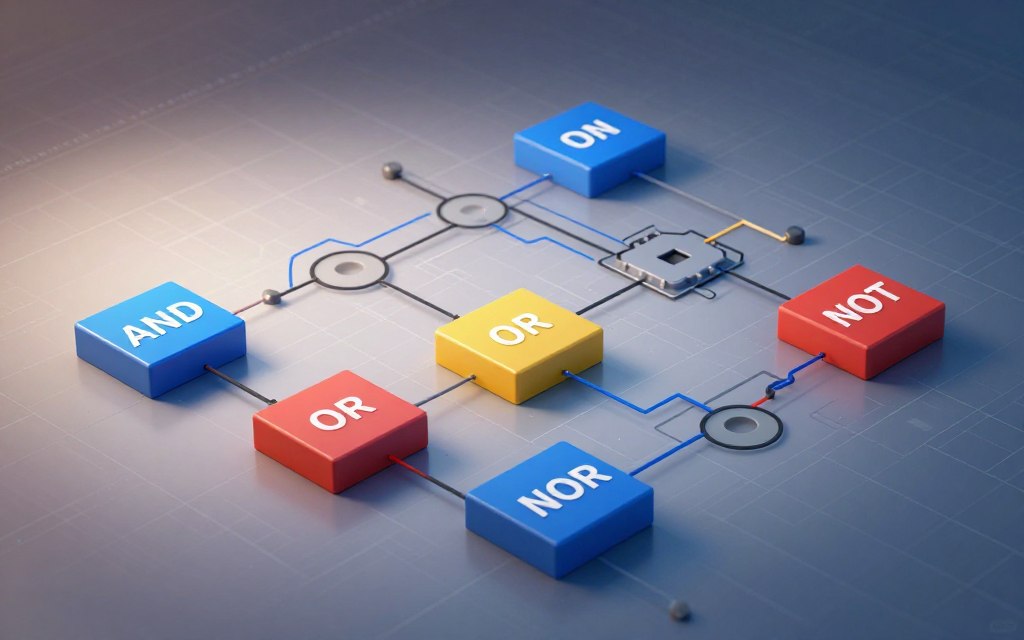
One primary use of Boolean algebra is designing and simplifying logic gates. Logic gates such as AND, OR, NOT, NAND, NOR, XOR, and XNOR use binary values and form digital circuits. These Boolean logic gates perform essential operations that control data processing.
Engineers use Boolean identities and truth tables to simplify circuit designs. Fewer gates can lower power use and increase propagation speed, creating more efficient hardware.
State Machines and Sequential Logic
Another key part of digital logic design is the study of state machines and sequential logic. Engineers build finite-state machines with states, transitions, clock signals, and registers to manage data flow.
These systems support controllers, communication protocols, processor units, and embedded devices. Unlike combinational logic, sequential logic uses current inputs and past states. This approach enables more complex, useful hardware designs.
Hardware Description Languages and Verification
Engineers use hardware description languages (HDLs), including Verilog, SystemVerilog, and VHDL, to express digital behavior and structure. These languages support hardware design and verification. Through mathematical logic, assertions, and simulation, engineers can test designs under many conditions.
The process of hardware description language verification confirms that designs behave correctly across expected and unexpected input combinations. This careful process supports reliable, functional digital hardware.
Boolean algebra is a practical tool that engineers use daily in computer hardware engineering. By mastering digital logic mathematics, engineers can create efficient, reliable, and innovative hardware solutions.
For further insights into Boolean algebra, you can explore more at this resource.
Probability, Statistics, and Reliability Analysis
Probability and statistics help engineers assess and improve hardware reliability. They also help manage uncertainty during hardware design and production. Together, they support hardware reliability analysis and better decisions.
Semiconductor yield prediction is critical. Tiny changes in materials, processing conditions, and dimensions can affect whether chips meet specifications. Statistical models estimate yield, find process problems, and measure design tolerance effects. Data helps engineers predict how many chips will work, supporting profitability.
Yield Prediction in Semiconductor Manufacturing
Engineers use statistical methods to forecast semiconductor manufacturing yield rates. Historical data reveals patterns, future performance, defect rates, and production variation.
Error Rates and Signal Integrity
Another key area is signal integrity testing. Engineers use probability to study bit errors, noise, and timing changes. Measurements and statistical distributions help keep signals within voltage and timing margins, preserving system performance.
Quality Control and Testing Methodologies
Quality control is vital in hardware engineering. Sampling, failure analysis, and accelerated life testing help assess product reliability. Confidence intervals and tolerance analysis guide component selection and production screening.
These methods can reduce warranty risks and extend a product’s expected operating life. Proactive semiconductor quality control helps products meet specifications and satisfy customer expectations.
For more insights on using technology in engineering, read this article on using AI to streamline and grow your.
Physics-Based Mathematics for Circuit and Chip Design
Mathematics and physics work together to predict real behavior in advanced computer hardware engineering. This knowledge helps engineers design circuits and chips that work reliably under many conditions. Physics principles also support efficient, effective hardware solutions through electromagnetic theory electronics.
Electromagnetic Theory and Maxwell’s Equations
Electromagnetic principles form the foundation for many electronic components. Maxwell’s equations hardware guide engineers who develop antennas, transmission lines, and high-speed interconnects. These equations help engineers assess key factors:
- Signal propagation
- Impedance matching
- Reflections and radiation
- Interference patterns
Engineers use field equations and computer models to ensure strong performance in electronic devices.
Semiconductor Physics and Device Modeling
Mathematical models help engineers understand semiconductor physics. These models describe charge carriers, electric fields, and junctions inside devices. Key aspects include:
- Transistor operation and switching behavior
- Diode characteristics and leakage current
- Threshold voltage determination
These models support integrated-circuit design and process development through semiconductor device modeling.
Thermal Dynamics and Heat Dissipation Models
As devices become smaller and more powerful, chip thermal management becomes critical. Engineers calculate heat flow, thermal resistance, and temperature gradients for reliable performance. They consider these factors:
- Cooling performance in chips and packages
- Heat dissipation in circuit boards
- Overall system thermal dynamics
Physics-based mathematics helps engineers develop reliable hardware for modern technology.
| Aspect | Importance | Application |
|---|---|---|
| Electromagnetic Theory | Guides design of RF components | Antennas, transmission lines |
| Semiconductor Physics | Describes device behavior | Transistors, diodes |
| Thermal Dynamics | Ensures effective heat management | Cooling systems, thermal resistance |
Conclusion
Computer hardware engineering relies heavily on mathematics. The math skills for hardware engineers depend on their roles and specialties. Digital logic engineers often use Boolean algebra, while analog and machine learning hardware engineers may use complex models.
Algebra, trigonometry, calculus, linear algebra, and statistics are essential. These subjects support hardware design and strengthen problem-solving skills. Physics-based equations help engineers design efficient, reliable circuits and chips.
Aspiring engineers should build a strong foundation in algebra and trigonometry. Studying calculus and linear algebra, practicing circuits and programming, and interpreting engineering tools prepare them for future careers. Math acts as a practical design language, helping engineers create faster, more reliable, energy-efficient hardware.
As you pursue a hardware design career, mastering these skills meets computer engineering math requirements. They can also open doors to innovative technology solutions.

 By
By