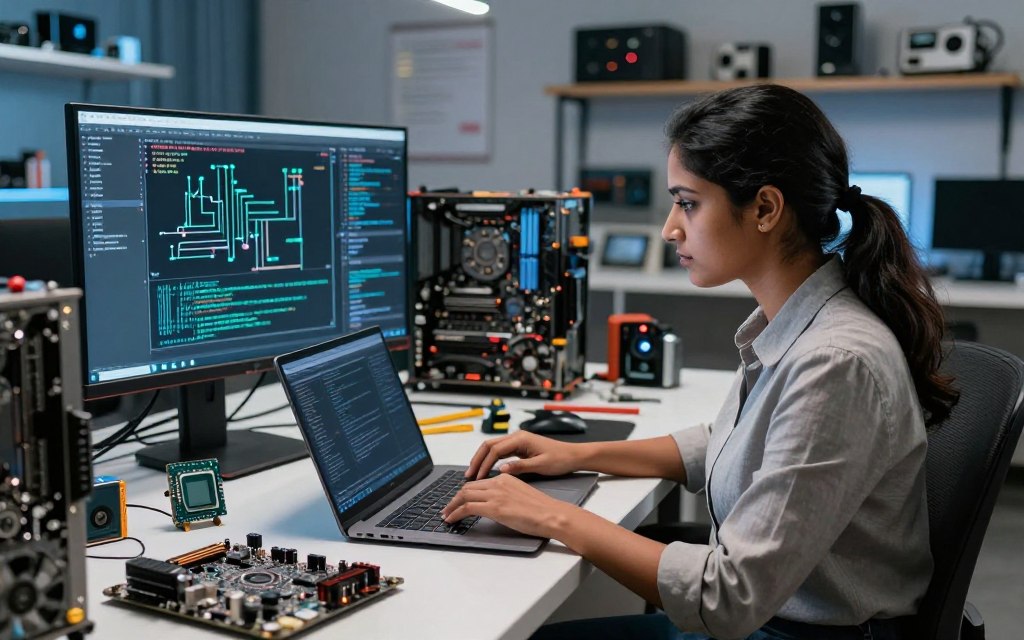

Do computer hardware engineers code? Yes, many do, but their programming work depends on their specialty. They often write code for hardware description languages, firmware, device drivers, and test automation. Unlike software engineers, they focus on embedded systems, simulations, and hardware instead of consumer applications.
This difference shows how hardware engineering overlaps with software while remaining a separate field. Coding is one part of the work. Other hardware engineering skills include circuit design, computer architecture, debugging, and systems analysis.
People planning computer engineering careers should explore education, employers, salaries, languages, and job titles. These topics can help them find hardware engineering jobs that match their interests. This overview explains what a computer hardware engineer does today and discusses future trends.
Key Takeaways
- Many hardware engineers engage in coding, focusing on specialized areas.
- Coding includes firmware, device drivers, and hardware description languages.
- There is a clear distinction between hardware and software engineering.
- Key skills include circuit design, debugging, and systems analysis.
- Career paths can vary widely, with diverse job titles and employers.
The Role of a Computer Hardware Engineer
Computer hardware engineering helps explain how technology works. These professionals design, develop, test, and improve physical computing systems. Their work covers processors, circuit boards, memory systems, and networking equipment.
Defining Computer Hardware Engineering
Computer hardware engineering focuses on creating and improving computer systems. A computer systems engineer may work with servers and specialized computing platforms. Common hardware engineer responsibilities include:
- Creating schematics and technical drawings
- Selecting appropriate components for systems
- Reviewing specifications and compliance standards
- Building prototypes for testing
- Analyzing performance metrics and troubleshooting issues
How Coding Integrates With Hardware Design
Coding supports hardware design in several important ways. Programming enables simulations, hardware description languages, and firmware development. Engineers use diagnostic tools and automated tests to check function and performance.
Not every hardware engineer spends the same amount of time coding. For example, a board designer may write less application code than an embedded engineer or FPGA developer. Still, all hardware engineers often use scripts and technical software daily.
Coding links electrical engineering, computer architecture, embedded systems, and software development. This hardware and software integration shows how these fields work together. Coding helps engineers control, model, verify, and test hardware systems, improving their effectiveness.
| Responsibility | Description | Importance |
|---|---|---|
| Creating Schematics | Developing detailed diagrams of circuits and systems. | Essential for accurate design and implementation. |
| Component Selection | Choosing the right parts for optimal performance. | Crucial for system reliability and efficiency. |
| Performance Analysis | Evaluating how well systems operate under various conditions. | Helps identify areas for improvement. |
Do Computer Hardware Engineers Code in Their Daily Work?
Coding plays an important role in a computer hardware engineer’s work. Not every engineer codes daily, but some specialties require it. Hardware description languages are one important example.
Hardware Description Languages in Practice
Hardware description languages (HDLs), such as Verilog and VHDL, help engineers design digital logic and integrated circuits. They model circuits and describe system behavior. Unlike traditional programming languages, HDLs focus on hardware design and simulation, not software applications.
Engineers also use FPGA programming through design synthesis, along with several other tasks:
- Simulation of circuit designs
- Synthesis for field-programmable gate arrays (FPGAs)
- Verification of digital systems
- Application-specific integrated circuit (ASIC) development
Embedded Systems and Firmware Programming
In embedded systems programming, engineers write firmware for microcontrollers and processors. They configure peripherals, manage memory, and optimize resource use. Common tasks include:
- Handling interrupts
- Communicating over various interfaces
- Ensuring efficient power management
Firmware development helps hardware components work correctly and interact smoothly with software applications.
Collaboration Between Hardware and Software Teams
Hardware software collaboration is vital in modern engineering projects. Teams define interfaces, exchange specifications, and solve problems together. For example, firmware errors can cause boot failures, while FPGA testing can reveal timing issues.
These examples show how coding helps engineers diagnose problems and validate complete products. Coding frequency depends on the engineer’s job title, the product’s development stage, and their expertise.
Essential Programming Languages for Hardware Engineers
Programming languages shape how hardware engineers design, test, and control electronic systems. Each language supports different hardware tasks. Learning these tools helps engineers succeed in this field.
C and C++ for Low-Level Development
C and C++ are core tools for low-level hardware work. C programming for hardware lets engineers communicate directly with components. C++ embedded development supports larger systems with more complex software.
Use Cases in Driver and Firmware Development
C and C++ are firmware programming languages used to build device drivers and firmware. They initialize hardware, manage interrupts, and connect systems with peripherals. This lets operating systems use hardware features effectively.
Python for Scripting and Automation
Python is rarely the main language on hardware with limited resources. It is valuable for scripts and automation because its syntax is simple and clear. Engineers use it for many hardware development tasks.
Python in Hardware Testing and Validation
Python hardware testing can automate measurements, study logs, and run regression tests. Hardware test automation improves testing speed and accuracy. Python is especially useful for hardware validation.
Verilog and VHDL for Digital Design
Verilog and VHDL are hardware description languages for digital logic design. They describe the behavior and structure of electronic systems. Both are crucial for creating digital hardware.
Choosing Between Verilog and VHDL
To choose Verilog vs VHDL, review project needs and existing codebases. Verilog has concise syntax, while VHDL uses strong typing and a structured approach. Employers often prefer one language based on their specific needs.
| Language | Primary Use | Key Features | Best For |
|---|---|---|---|
| C | Firmware Development | Low-level access, performance | Device drivers, real-time systems |
| C++ | Embedded Development | Object-oriented, abstraction | Complex embedded software |
| Python | Scripting and Automation | Easy syntax, libraries | Testing, data processing |
| Verilog | Digital Design | Concise syntax | FPGA design, simulation |
| VHDL | Digital Design | Strong typing, structured | Complex systems, academic projects |
Key Technical Skills Beyond Coding
Coding is vital to a computer hardware engineer’s toolkit, but it is only one part of the work. Engineers also need circuit design skills, computer architecture knowledge, and engineering problem-solving.
Circuit Design and Analysis
Circuit design skills are fundamental to electronics engineering. Engineers create schematics that show how components interact within a circuit. They choose parts, ensure efficient power delivery, study both signal types, create PCBs, and use equipment to validate performance.
Understanding signal integrity is crucial because it affects circuit function. Engineers must know voltage, current, timing, noise, and thermal behavior to meet required specifications. These factors can greatly affect device operation under different conditions.
Computer Architecture Knowledge
Strong computer architecture knowledge is essential for hardware engineers. It covers processors, memory hierarchies, buses, and input/output systems, plus their interactions. This knowledge helps engineers predict design performance under different workloads.
For instance, understanding caches and instruction execution can guide performance decisions. Engineers who understand these relationships can design systems that work well with firmware. This leads to more efficient and reliable products.
Problem-Solving and Debugging Techniques
Effective problem-solving is a skill every hardware engineer must develop. Hardware debugging requires a methodical process: reproduce issues, isolate variables, and form testable hypotheses. Measurements and log reviews help explain differences between expected and actual behavior.
Tools such as oscilloscopes, logic analyzers, and multimeters are invaluable in this process. Engineers also use simulation environments and version-control systems to track changes, collaborate with teams, and improve hardware debugging. Clear documentation and communication help engineers explain complex failures to software, manufacturing, and management teams.
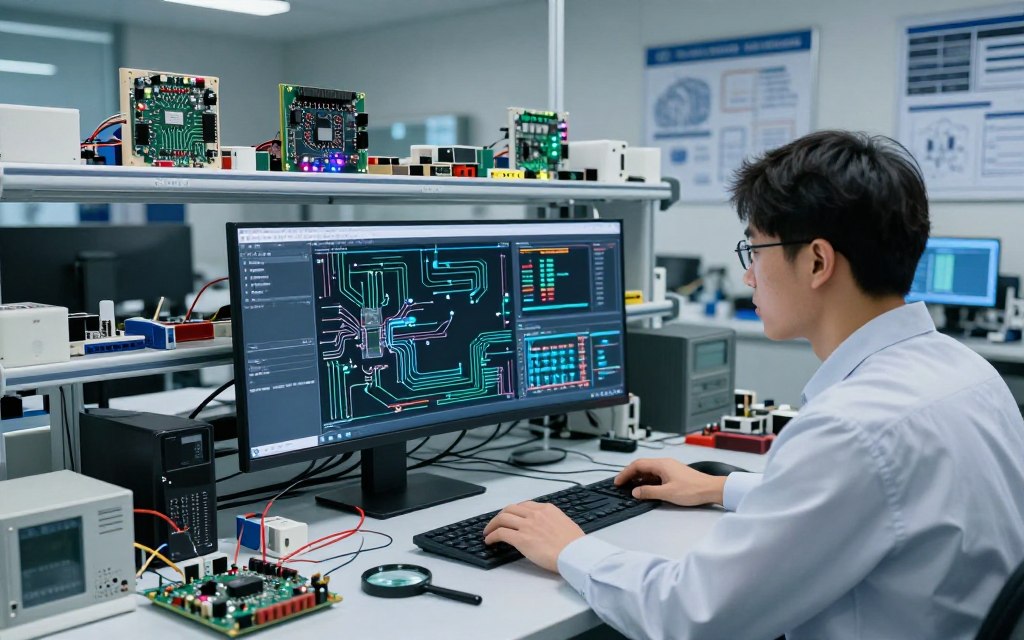
In conclusion, successful hardware engineers need more than programming. Mastering circuit design, computer architecture, and problem-solving techniques helps them create innovative solutions in a rapidly changing field. For further insights into essential skills for embedded systems software engineers, check out this resource.
Educational Pathways and Certifications
Choosing the right pathway, including a hardware engineering degree, helps aspiring hardware engineers build a strong start. In the United States, students often pursue a computer engineering degree, an electrical engineering degree, or hardware-focused computer science. These programs usually cover key subjects needed for a career in hardware engineering.
Key topics include digital logic, circuits, electronics, computer architecture, microprocessors, embedded systems, operating systems, programming, and signal processing. Project-based coursework lets students apply theory in practical settings. Internships and senior design projects build hands-on experience and improve employability.
A graduate degree can help people seeking advanced research or specialized fields, such as semiconductor development. However, it is not required for every entry-level role. Many employers value solid undergraduate education, practical experience, and a robust portfolio.
Degree Programs in the United States
Undergraduate programs in hardware engineering usually offer a broad curriculum. Students should seek institutions that emphasize embedded systems education and hands-on training. Look for programs that provide courses in:
- Digital Logic Design
- Microprocessor Systems
- Embedded Systems Development
- Computer Architecture
- Signal Processing
These courses equip students to tackle real-world challenges in hardware engineering. This engineering training can deepen understanding and strengthen technical skills through research projects.
Industry Certifications and Professional Training
Alongside formal education, pursuing hardware certifications can strengthen a candidate’s profile. Certifications for technologies such as FPGA or embedded platforms show expertise and commitment. Networking qualifications and professional development courses can also give candidates a competitive edge.
Employers often seek education, practical experience, and relevant certifications. Because technology evolves quickly, continuing education remains vital. Career advancement requires staying current with the latest tools, processors, and verification methods.
Aspiring hardware engineers should choose training that matches their career objectives. Instead of collecting credentials without focus, they should align education with specific job roles.
Career Opportunities and Job Titles
Hardware engineering offers many job opportunities. Aspiring engineers can choose entry-level or specialized roles. Learning these roles can guide an engineering career path.
Entry-Level Hardware Engineering Positions
Entry-level jobs help engineers gain experience and build skills. Common hardware engineer job titles include hardware engineer, embedded hardware engineer, and FPGA engineer. In these roles, engineers review schematics, research components, and assemble prototypes.
Typical Responsibilities and Expectations
As an entry-level hardware engineer, you will be expected to:
- Read and interpret technical documentation.
- Utilize laboratory tools for testing and debugging.
- Write basic scripts or firmware.
- Follow established design processes.
- Communicate findings clearly with team members.
Senior and Specialized Roles
With experience, hardware engineers can move into senior roles. Titles may include senior hardware engineer, ASIC design engineer, or systems architect. Specialized roles focus on areas like signal integrity or power electronics.
Career Advancement Paths
Advancement in hardware engineering typically involves:
- Gaining deeper technical expertise.
- Taking ownership of larger systems.
- Mentoring junior engineers.
- Leading cross-functional teams.
- Making critical product decisions.
Salary Expectations in the United States
Salary is an important factor when choosing hardware engineering. The hardware engineering salary can vary widely for several reasons.
Factors Affecting Compensation
Compensation is influenced by:
- Experience level and education.
- Technical specialization and industry.
- Geographic location and market demand.
- Type of employer, such as semiconductor or aerospace companies.
Top Employers Hiring Hardware Engineers
Hardware engineering employers span many industries, including technology, government, and defense. Technology hardware jobs also appear beyond traditional technology companies, showing the field’s wide reach.
Leading Technology Companies
Many semiconductor companies and leading technology firms hire hardware engineers. They build processors, graphics hardware, servers, and cloud infrastructure. Notable names include:
- Intel – Renowned for its microprocessors and chipsets.
- NVIDIA – A leader in graphics processing units (GPUs) for gaming and AI.
- Apple – Innovates in consumer electronics and mobile devices.
- Google – Engages in hardware for data centers and consumer products.
- Amazon – Develops cloud infrastructure and consumer electronics.
These companies often offer roles in hardware design, firmware development, and systems engineering. Openings and hiring conditions can change quickly, so candidates should stay informed.
Government and Defense Contractors
Hardware engineers can find rewarding careers with government agencies and defense contractors. Their work includes aerospace hardware engineering, secure communications, radar, avionics, and electronic warfare systems. Defense contractor jobs often require systems engineering skills, reliability, and security clearance eligibility.
Applicants seeking government hardware careers should review each job description for tools, terms, board design, firmware, and validation needs. They should also check travel and clearance requirements. Relevant projects and product lifecycle knowledge can strengthen a candidate’s profile.
Future Trends in Hardware Engineering
The future of hardware engineering is shaped by AI and emerging hardware technologies. Demand for specialized hardware in artificial intelligence and machine learning is changing the field. Engineers design processors and accelerators for parallel workloads, energy efficiency, and memory bandwidth.
Hardware engineers design and test GPUs, neural-processing units, and custom accelerators. They also build high-performance memory systems and interconnects for modern data-center platforms. This work links hardware engineering with coding, hardware description languages, firmware, driver development, and performance modeling.
AI and Machine Learning Hardware Development
The rise of AI hardware engineering has increased interest in machine learning accelerators. These specialized components improve AI applications as companies seek faster processing. Demand for semiconductor innovation has surged, including traditional chips and new architectures for AI workloads.
Quantum Computing and Emerging Technologies
Quantum computing hardware marks another frontier in hardware engineering. Quantum systems need control electronics, cryogenic environments, precise measurement, and error correction. The field remains exploratory, with career paths that differ from conventional digital design.
Beyond AI and quantum technologies, emerging hardware technologies are gaining traction. These include chiplet architectures, three-dimensional packaging, edge computing, and neuromorphic computing. Each innovation requires knowledge of electronics, computer architecture, and software development.
As the industry evolves, future engineers need strong skills in circuits, digital logic, programming, testing, and problem-solving. These durable fundamentals will remain useful as tools and product categories change.
| Emerging Technology | Key Focus Areas | Engineering Challenges |
|---|---|---|
| AI Hardware | Parallel processing, energy efficiency | Designing specialized accelerators |
| Quantum Computing | Control electronics, error correction | Operating in cryogenic environments |
| Chiplet Architectures | Modular design, performance scaling | Interconnect complexity |
| Neuromorphic Computing | Brain-inspired architectures | Modeling cognitive processes |
Tips for Aspiring Hardware Engineers
To thrive in hardware engineering, build a strong portfolio and practice engineering networking. Both show your skills and help you find opportunities in this competitive field.
Building a Strong Portfolio
Creating a comprehensive hardware engineering portfolio is essential. Include embedded systems projects and FPGA project ideas that show design and coding skills.
- A microcontroller-based sensor system
- A custom circuit board
- An FPGA implementation
- A small computer architecture project
- An automated hardware test setup
- A robotics controller
- A device-driver and firmware demonstration
For each project, document the design goals, requirements, schematics, code, testing, measurements, failures, revisions, and final results. This detail shows technical skill and problem-solving ability.
Publishing your work online can increase your visibility. Use a personal website, code repository, technical write-ups, diagrams, photographs, and short demonstrations. Protect confidential project information.
Networking and Professional Development
Engineering networking matters as much as technical skill. Join student engineering organizations, attend IEEE activities, and participate in university laboratories. Conferences, hackathons, and open-source communities help you meet professionals.
Use your alumni network and seek hardware internships for real-world experience. Informational interviews can offer useful insight. Ask focused questions about daily responsibilities, tools, hiring requirements, and hardware engineering career paths.
Tailor your resume to highlight programming languages, instruments, CAD or EDA tools, processors, interfaces, verification methods, and measurable project outcomes. This targeted approach can improve your job applications.
Prioritize continuous learning and professional communication. Stay current with technology and seek mentorship opportunities. These efforts improve your skills, support professional development for engineers, and build your industry reputation.
| Project Type | Skills Demonstrated | Documentation Required |
|---|---|---|
| Microcontroller System | Embedded Programming | Goals, Code, Testing |
| Custom Circuit Board | Circuit Design | Requirements, Schematic |
| FPGA Implementation | Digital Design | Code, Results |
| Robotics Controller | Control Systems | Failures, Revisions |
Conclusion
Understanding computer hardware engineers means seeing how coding supports hardware design. The do computer hardware engineers code answer is clear: They do, but the extent varies by specialization. Engineers use C and C++ for firmware, Python for automation, and Verilog or VHDL for digital design.
These skills complement knowledge of circuit design and computer architecture.
A hardware engineering career offers diverse opportunities. Entry-level positions include validation and embedded systems, while senior roles include architecture and FPGA design. Match your education and portfolio to your career path, because computer hardware jobs require different skills.
Employers value practical experience, problem-solving, collaboration, and documentation skills. Connecting hardware behavior with software outcomes is a key part of the job. To succeed, build projects, learn programming for hardware engineers, and seek hands-on experience.
Networking with professionals can provide insight into current trends and job qualifications.
For those seeking to become a hardware engineer, United States job descriptions can reveal in-demand skills. Embrace the journey and take proactive steps toward a fulfilling hardware engineering career.

 By
By